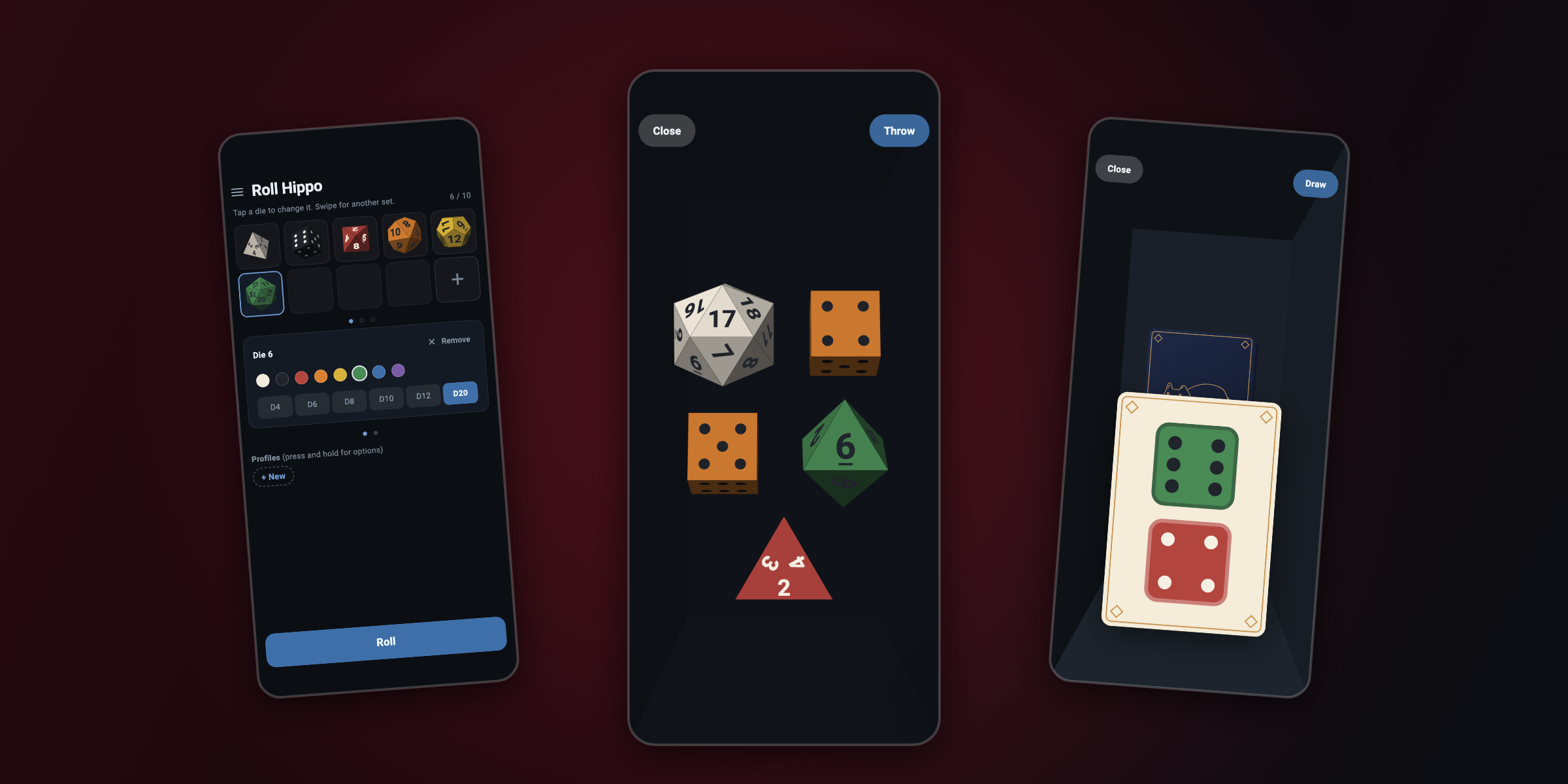
Two ways to get a roll, and Roll Hippo is equally both. Deal a card from a
shoe holding every outcome your dice could produce, drawn without
replacement and cut where you like — the same wager as the throw, with the
one thing a shoe adds. Or throw them for real: set your dice up once, up to
ten of them, any mixture of D4 through D20 — plus a poker die — then hold
the phone upright and
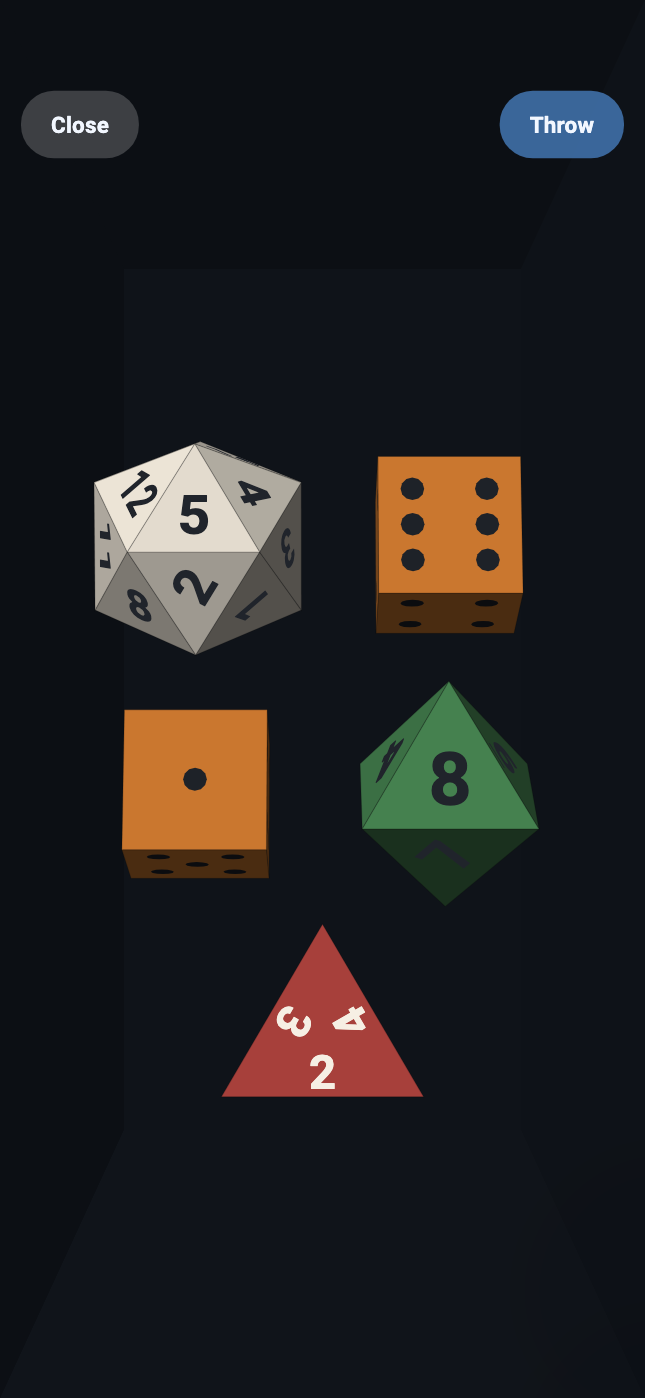
shake it. They tumble inside a box the size of the screen on a real
rigid-body simulation and settle where they settle.
The box is the size of your phone and 20 cm deep, and it is simulated
in the phone's own frame of reference — so the walls never move and the
acceleration inside them comes straight off the accelerometer. There is no
shake threshold and no gesture to learn, because tilting and shaking are
the same number arriving from the same sensor.
The shoe is the other half, and it is the same care applied to a different
question. A deck holds every ordered outcome of your dice, once
each, so drawing a card is the same wager as making the throw it stands
for. What it adds is the thing a shoe has always been for: it is dealt
without replacement, so what has already gone tells you something about
what is left, and you decide with the cut how much of that you want.
Up to four shoes at once, each with its own dice, decks and cut, swiped
between the way the trays are — a shoe is its own memory, and two of them
side by side stay two.
The number is landed on, not chosen. Roll Hippo does not
pick a result and animate towards it. Each die is thrown with a uniformly
random orientation and speed, it tumbles, and the value you read is read
off the die's own orientation once it has stopped — the face that
finished pointing up, or for the D4 the face it came to rest on. Every
solid is isohedral, and each one's inertia tensor is computed from its own
geometry rather than copied from a table, because a die whose inertia is
wrong is a loaded die.
Shake it, and they tumble
The accelerometer and gyroscope drive the box directly, so a wrist
flick turns into a tumble rather than a slide. Tilt it and the dice
pour down the screen. No button to press — though there is one, for
when your hands are full.
Or deal it from a shoe
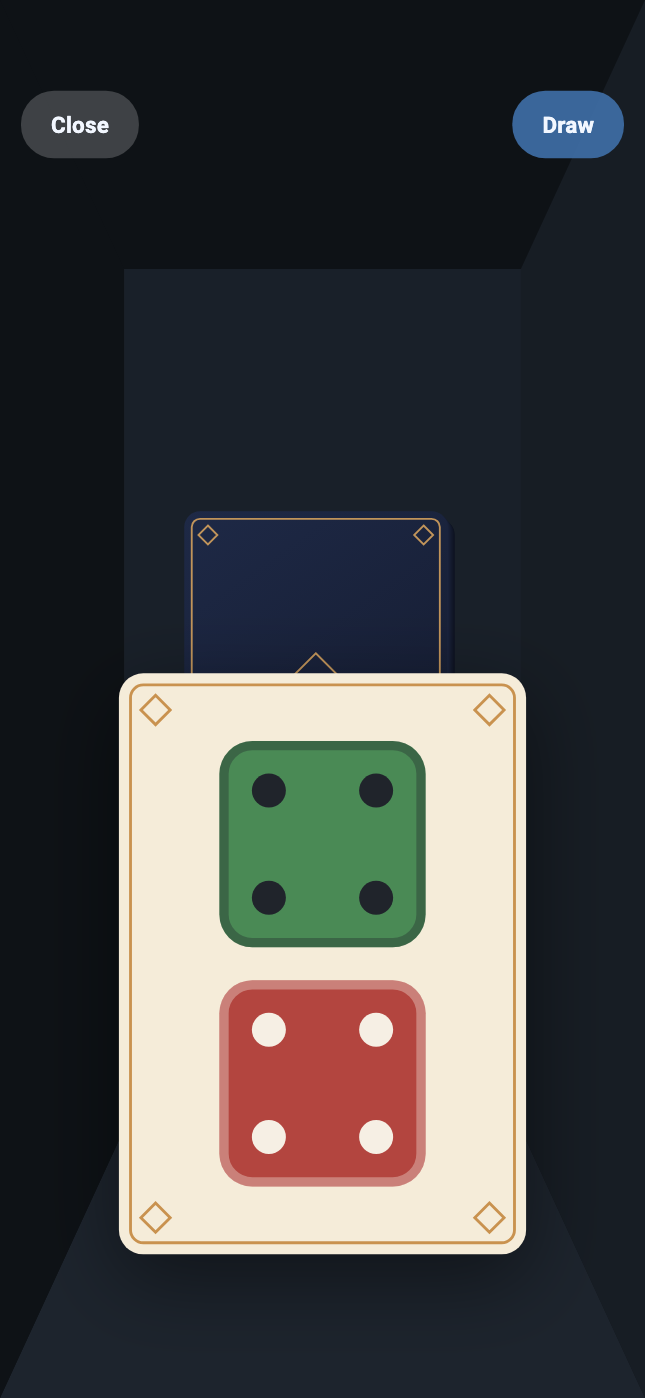
One card for every ordered outcome of your dice — 1-2 and
2-1 are two ways for a pair to land where snake eyes has only one, so a
deck that held each pair once would make every double twice as likely
as it is. Up to three decks, dealt without replacement. Cut it where you
like and it reshuffles when it gets there.
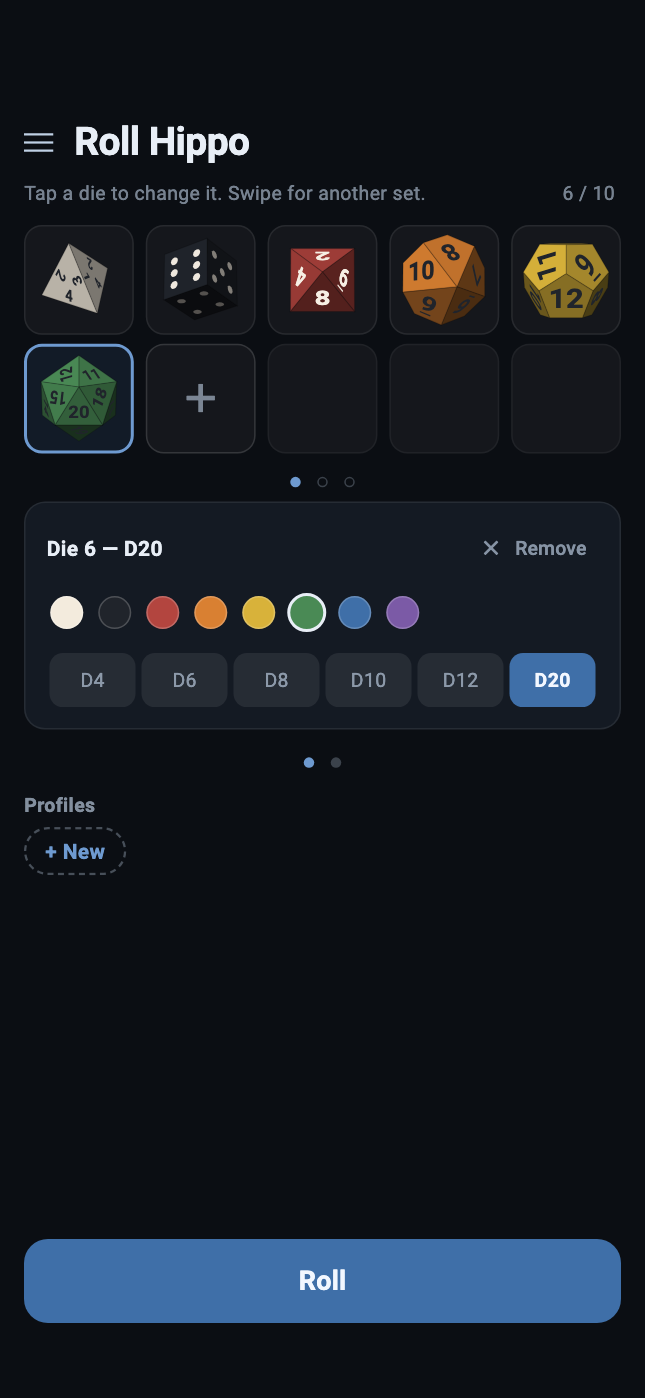
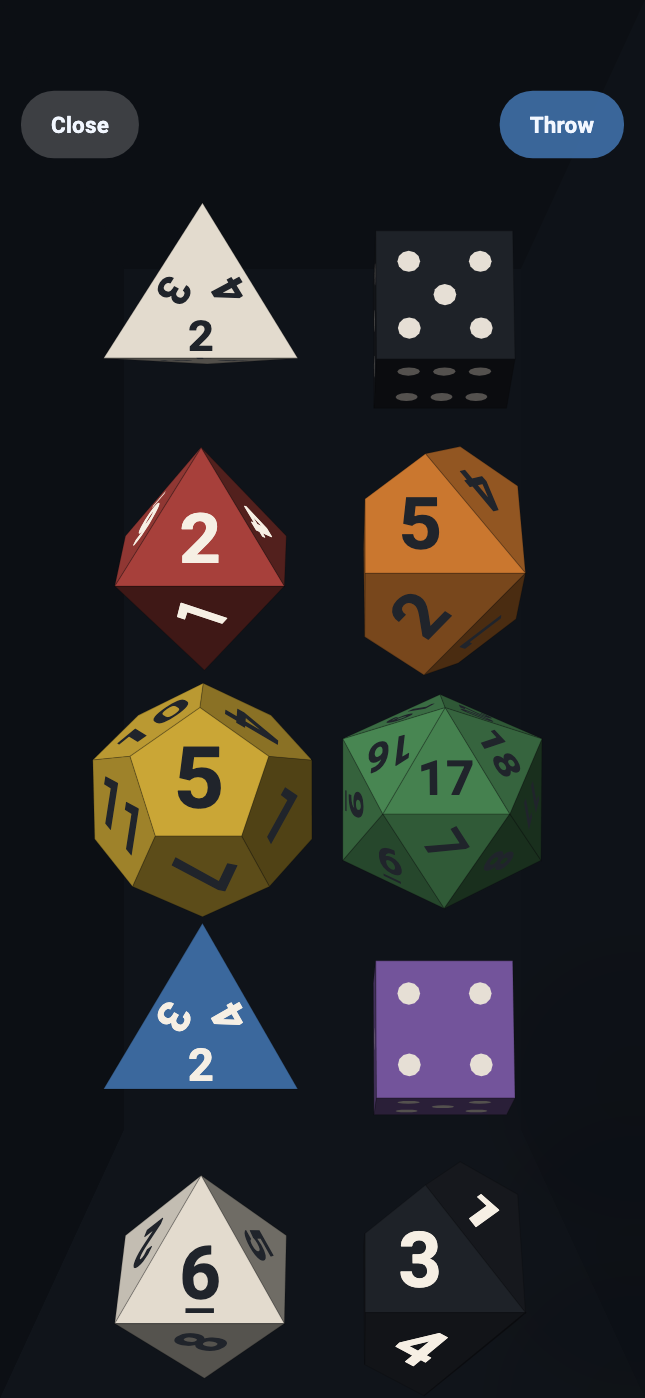
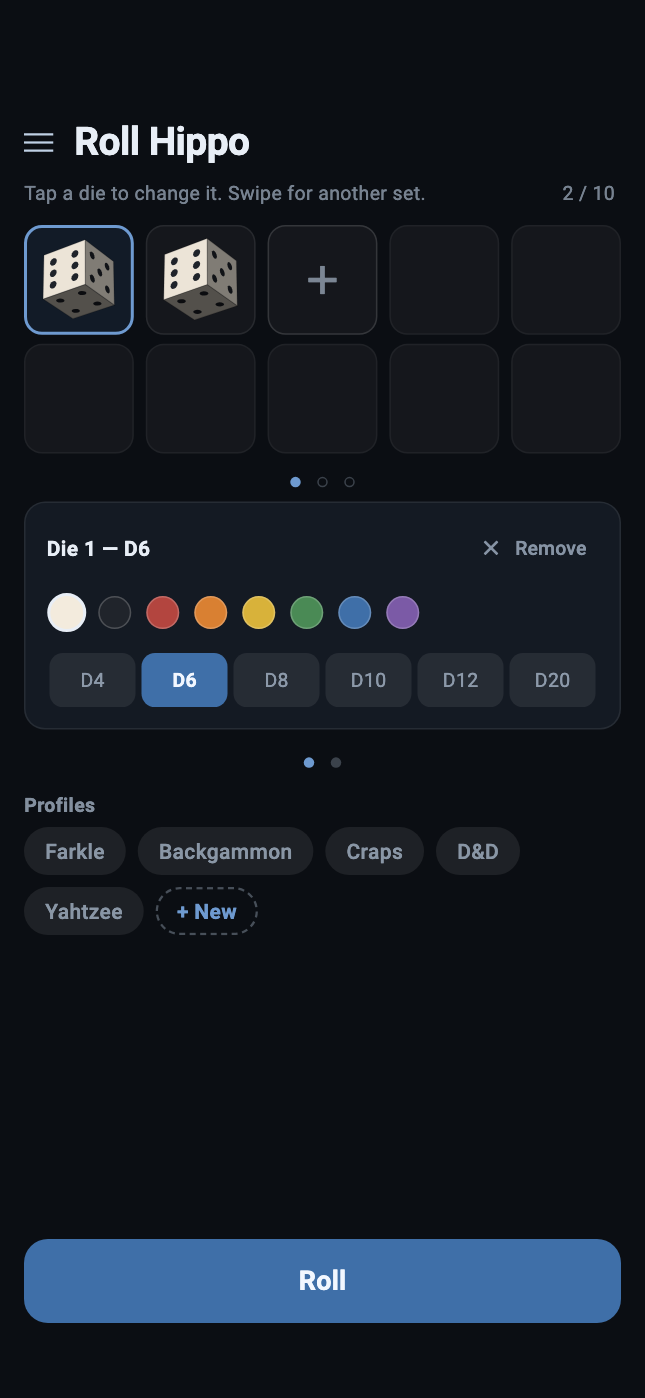
Seven kinds, ten dice, your colours
D4, D6, D8, D10, D12 and D20 — every one of them a real polyhedron
with its faces, its numbering and its mass found from its vertices —
and a poker die, which is a D6 printed with the six cards it stands
for. Ten in the tray at once, in any mixture, each picked out in a
colour of its own.
Several trays, several results
Set up as many as four separate groups — the picker offers you one
empty page at a time, so they arrive as you fill them — and swipe
between them. A tray you are not looking at is not simulated at all, so
the numbers a group rolled stay the numbers it rolled — a swipe cannot
shake them, and neither can anything happening next door.
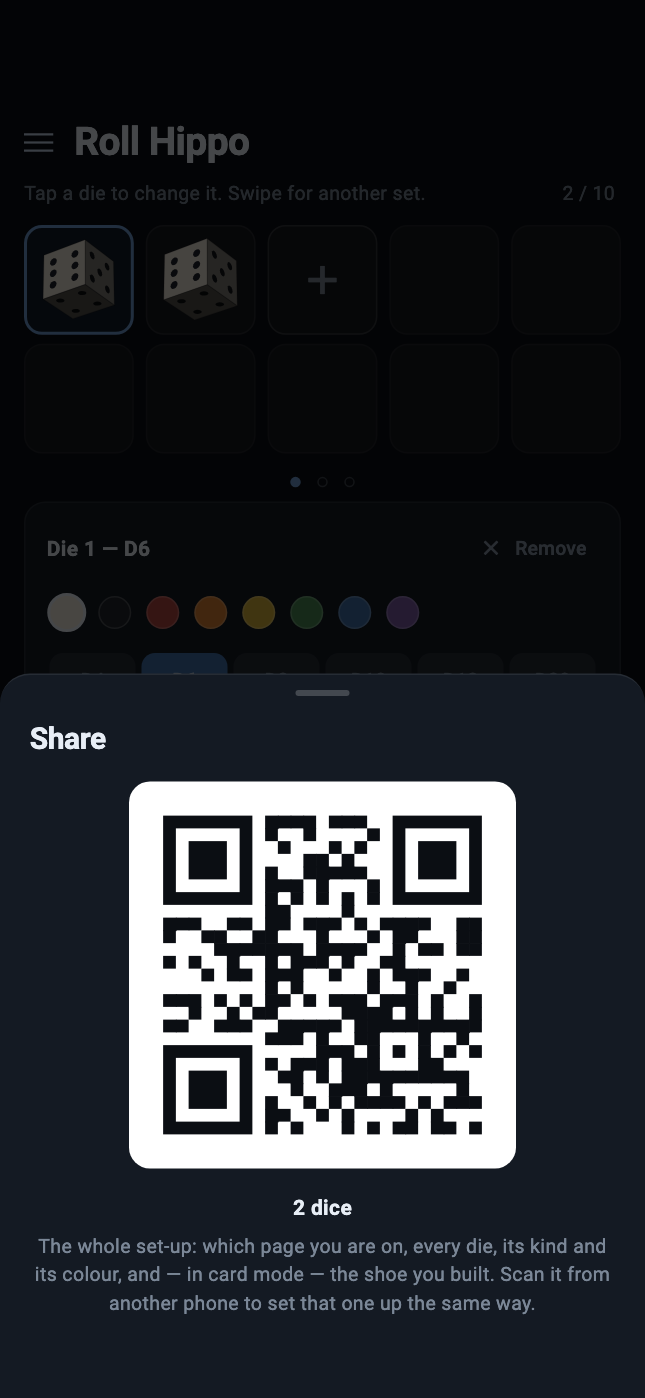
Save a set-up, share the square
Keep the sets you actually play under names you choose, and reopen
one in a tap. A profile turns into a QR code that carries the whole
thing — every die, its kind and its colour, the mode and the shoe — so
the next player points a camera at your screen and has it too.
It works with the SIM out
No account, no network call, no analytics, no ads, no update ping.
Nothing about you leaves the phone, because nothing leaves the phone.
Prefer the dice without the shaking? Turn motion control off and the
buttons are the whole interface.
A look at it
Every screen, as it ships
These are captures of the real app, rendered from the same widgets the
phone runs. Push them sideways.
Pick your diceTap a slot to change its kind or its colour. The rack holds ten.Then shakeThey fall, bounce, tumble and stop. What is showing is what they landed on.Ten at onceAny mixture. They are all as wide as a 16 mm D6, so any set packs.Deal them insteadOne card per possible roll, drawn from the shoe without replacement.Keep the ones you playSaved under your own names, and reopened in a tap.Hand it overThe whole set-up as one square. Scan it from another phone.
Feedback
Ask for the thing that isn’t there
Roll Hippo is built around games somebody actually plays, which is
exactly why the gaps in it are invisible from the inside. If the die your
game wants isn’t in the rack, if your table cuts a shoe somewhere
the slider won’t reach, or if a screen reads wrong on the phone you
actually own, nothing here finds that out on its own. Say what the game
is and what it needed, and it turns into something that can be built.
All of it goes to one place — the
issue
tracker on GitHub, beside the source. It is public on purpose:
somebody may have asked for your feature already and can say so, and if
the answer turns out to be no, the reason stays attached to the question
instead of ending up in one person’s mailbox. A free GitHub account
is the whole of what it costs.
A bug report has to carry what the app cannot send.
There is no crash reporting in Roll Hippo and no telemetry of any kind,
so a wrong result or a stuck screen leaves no trace anywhere but the
phone it happened on — until somebody writes it down, nobody knows it
happened. The phone, its OS version and what was on screen are usually
enough; if a particular set of dice is involved, the QR code from the
app’s Share sheet carries the entire set-up in one picture.
Roll Hippo is the herd's first mobile app: one Flutter codebase, shipping
to the App Store and to Google Play. It is on the App Store now; the Play
listing is still to come. It is free and Apache-2.0, and it will stay
that way.
 Roll Hippo